
- home
- Dollars
- Early Dollars
- Bust Dollars
- Draped Bust Dollar Heraldic Eagle Reverse 1799 Fine To Very Fine
- Back to:
- Bust Dollars


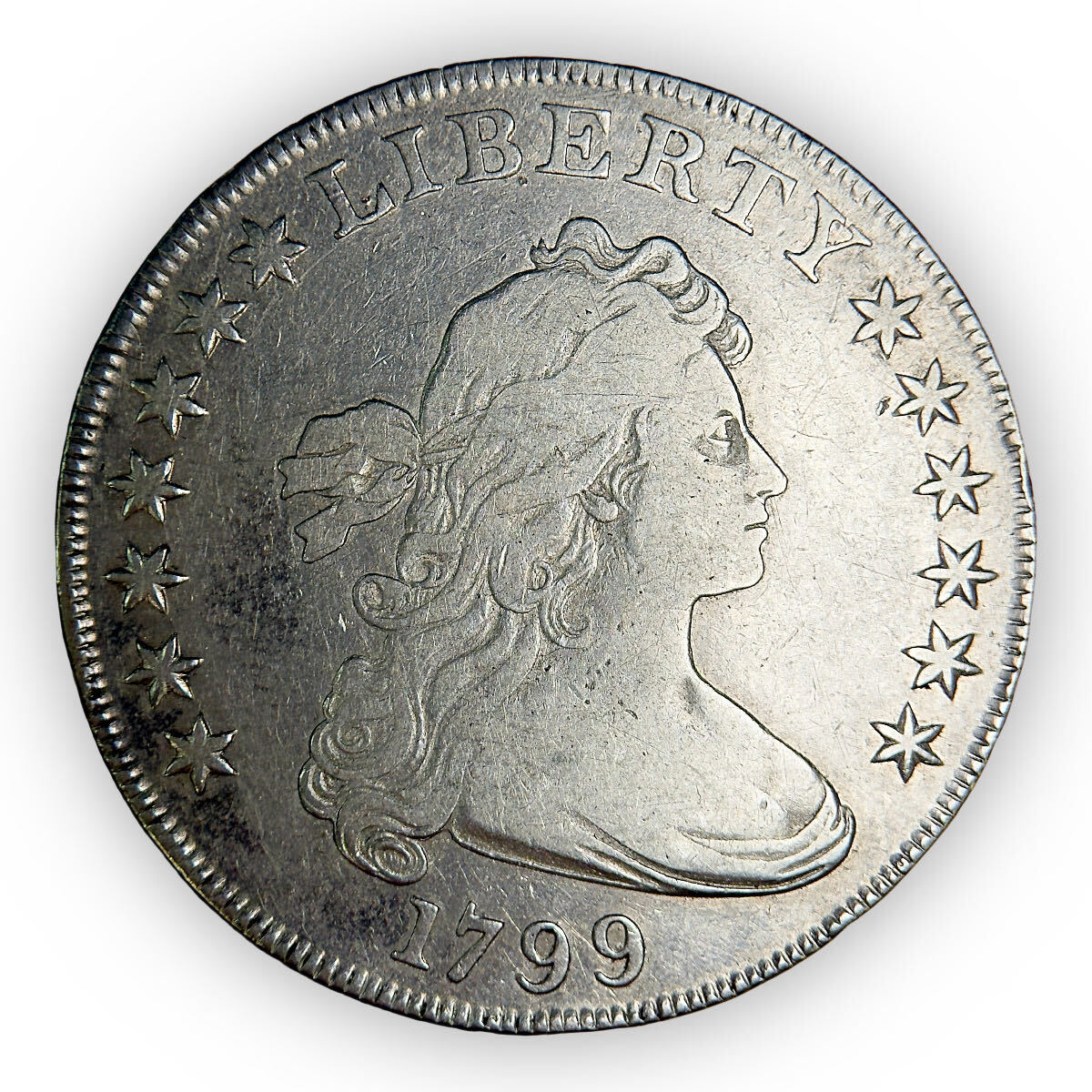
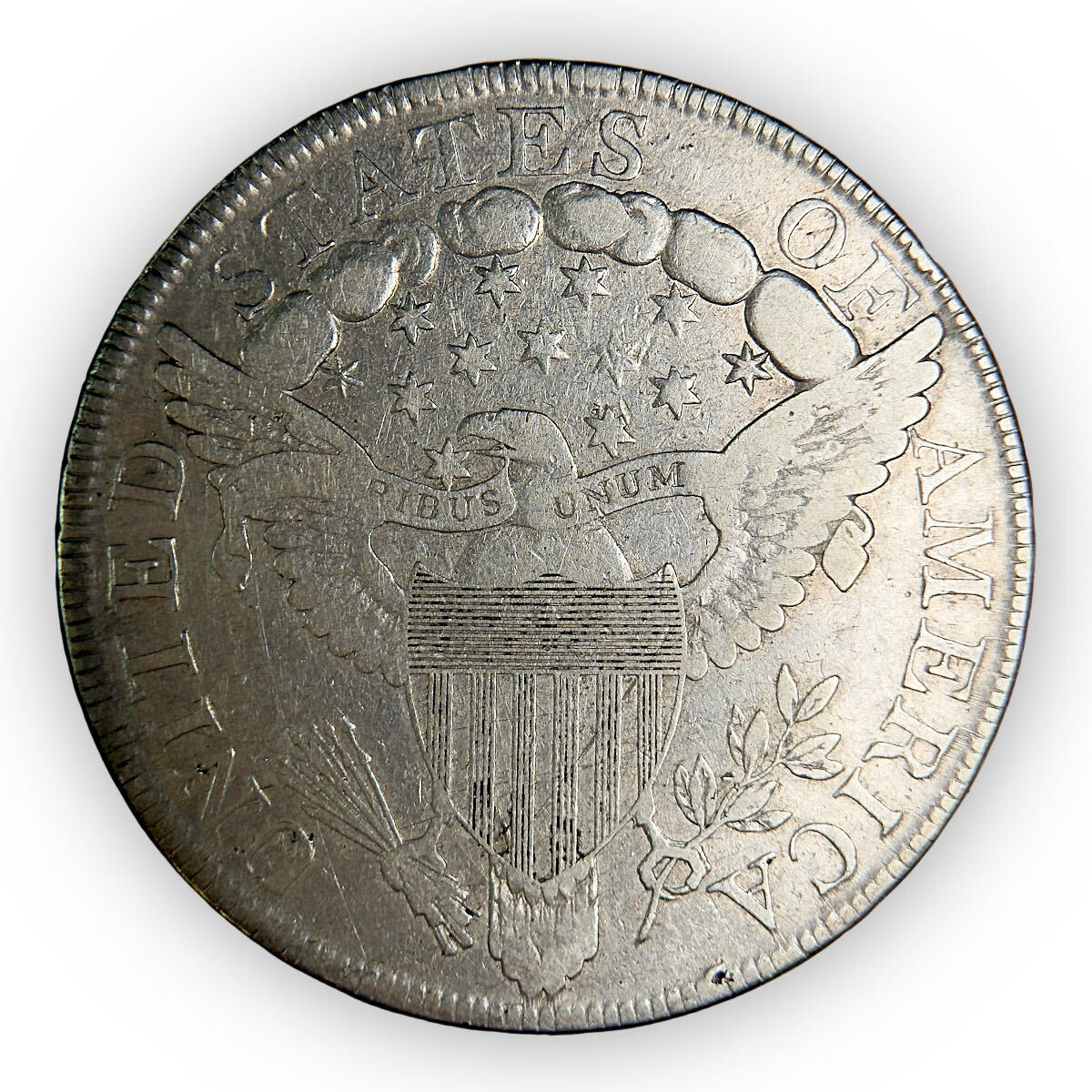
Draped Bust Dollar Heraldic Eagle Reverse 1799 Fine To Very Fine
| Qty | Wire/Check | Bitcoin | CC/Paypal |
| Any | $2,450.00 | $2,474.50 | $2,548.00 |
The Draped Bust Dollar with Heraldic Eagle reverse dated 1799 is one of the most widely recognized and sought-after early American silver dollars. Struck at the Philadelphia Mint, the only operating mint at the time, the 1799 issue belongs to the second subtype of the Draped Bust Dollar, which featured the Heraldic Eagle reverse from 1798 through 1804. Composed of 89.24% silver and 10.76% copper, each coin weighed 26.96 grams and measured about 39 to 40 millimeters in diameter. Surviving examples in Fine to Very Fine (F–VF) condition offer collectors a handsome balance of affordability and detail, with sufficient design clarity to enjoy the artistry while also showing the marks of long circulation in the young republic.
The Draped Bust design replaced the earlier Flowing Hair motif in 1795, when critics called for a more refined and elegant depiction of Liberty. The new design, prepared by Chief Engraver Robert Scot, was inspired by sketches attributed to famed portraitist Gilbert Stuart. The obverse features a right-facing bust of Liberty, her flowing hair tied back with a ribbon, with classical drapery around her neckline. The word “LIBERTY” appears at the top, while the date “1799” anchors the bottom. Thirteen stars symbolizing the original colonies are arranged around the portrait, usually in a 7–6 or 8–5 pattern depending on the die marriage. On an example in Fine to Very Fine condition, Liberty’s profile and hair outline remain visible, though interior detail is worn. Drapery folds are faint but still identifiable, and the stars and legends are bold and legible.
The reverse of the 1799 dollar showcases the Heraldic Eagle, modeled loosely on the Great Seal of the United States but with differences unique to early Mint engraving. The eagle spreads its wings proudly, a striped shield covering its breast. In its talons it clutches an olive branch in one and a bundle of arrows in the other, symbols of peace and preparedness for war. Above the eagle, a cluster of clouds and stars form an arc, representing a new nation among the powers of the world. The inscription “UNITED STATES OF AMERICA” circles the rim. On a coin in Fine grade, the eagle’s body and wing outlines are clear though flattened, while on a Very Fine piece, portions of feather detail remain visible and the shield shows partial line definition. Legends and major devices remain strong at both grades, making the reverse highly attractive despite wear.
The 1799 Draped Bust Dollar is among the more available dates in the series, though “available” is relative when dealing with early American dollars. Official Mint records report a mintage of 423,515 pieces, a large figure for the time and one of the highest totals for the Draped Bust Dollar. However, attrition from circulation, melting, and exportation means that far fewer survive today. Large numbers of silver dollars were shipped overseas, where they circulated in Europe or were melted for bullion, leaving relatively few examples for modern collectors. This higher mintage does make 1799 a popular “type coin” date, as it is more accessible than scarcer issues like 1795, 1796, or 1802.
The condition range of Fine to Very Fine provides collectors with a satisfying level of detail while keeping the coin more affordable than higher-grade examples. In Fine condition, Liberty’s portrait and the eagle are clear in outline, but interior details such as hair strands and feathering are mostly worn smooth. In Very Fine, more of these finer details begin to reappear: Liberty’s drapery folds are more distinct, portions of her hair show definition, and the eagle’s wings and shield carry additional texture. The stars, legends, and date are sharp and readable at both grades, providing strong visual appeal even without Mint State sharpness.
The symbolism of the Draped Bust Dollar is powerful. Liberty, depicted in neoclassical style, tied the young United States to ideals of democracy, virtue, and civic identity drawn from ancient Greece and Rome. The Heraldic Eagle, with its olive branch and arrows, symbolized balance between peace and defense, while the constellation above the eagle illustrated the new nation joining the global community. Together, these motifs reinforced both the internal ideals and external aspirations of the fledgling United States.
For collectors, the 1799 Draped Bust Dollar represents one of the most desirable opportunities to own an early American silver dollar. Its higher mintage compared to other years means it is more available, yet it retains all the charm and historical weight of the series. In Fine to Very Fine condition, it offers an ideal balance of historical character, affordability, and design clarity, with enough detail preserved to appreciate the artistry of Robert Scot’s engraving. The coin’s large silver planchet also provides substantial physical presence, making it a showpiece in any early U.S. collection.
Beyond numismatic value, the 1799 dollar is a piece of living history. Minted just 23 years after American independence and during the presidency of John Adams, it circulated in an economy still finding its footing. Coins like this likely passed through the hands of merchants, farmers, and statesmen, serving both practical purposes in commerce and symbolic purposes as a testament to the nation’s sovereignty. Its survival after more than two centuries, even with wear, testifies to its durability and to the importance collectors place on preserving these early issues.
In conclusion, the Draped Bust Dollar with Heraldic Eagle reverse dated 1799 in Fine to Very Fine condition is a historic and highly collectible piece of early American coinage. With its bold Liberty portrait, heraldic eagle, and classical symbolism, it embodies the ideals of a young republic. Its relatively higher mintage makes it more accessible than some other Draped Bust dates, yet it remains a scarce and coveted coin in today’s market. For collectors seeking to add an early silver dollar to their holdings, a 1799 example in F–VF condition offers the perfect combination of history, artistry, and value.


